
It happens to almost every founder building their first clothing brand. You have designs you are excited about. You need someone to help bring them to life. You search online, ask in forums, reach out in Facebook groups.
And then you get a reply from a dressmaker who says she can make your samples. Or a seamstress who says she has done this kind of work before. Or a tailor who says he can sort the patterns and the samples together.
Some of these people are skilled and talented at what they do. But what they do may not be what you actually need — and the difference is significant, expensive to discover, and very commonly made.
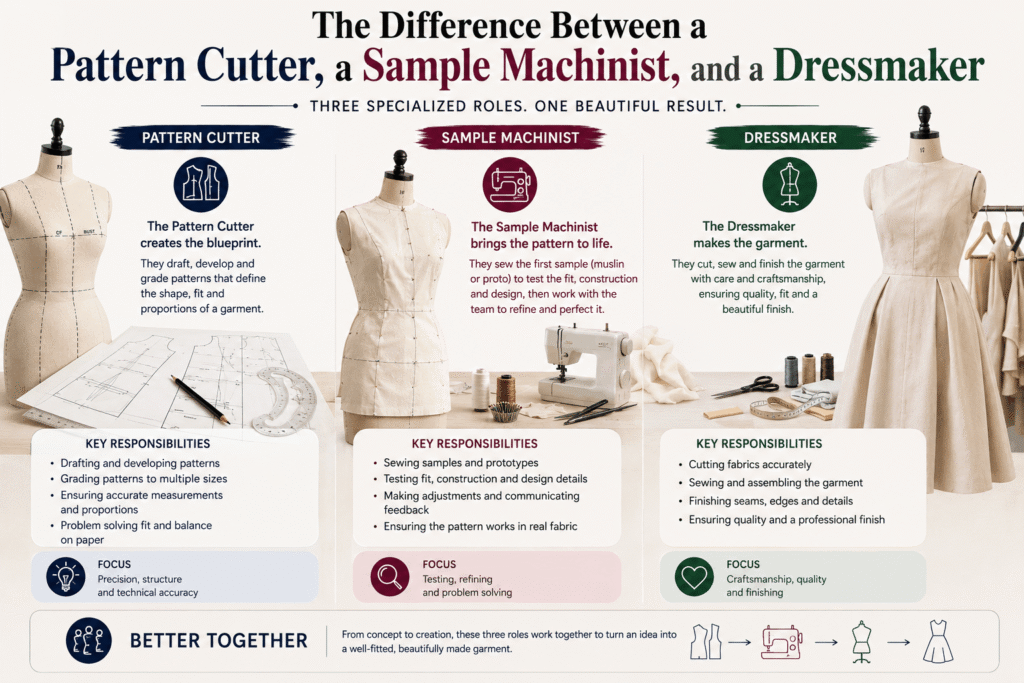
This guide separates three roles that are constantly confused in the startup fashion brand world: the pattern cutter, the sample machinist, and the dressmaker. Who does what, what training each requires, why they are fundamentally different, and what happens when the wrong one is used for the wrong job.
Why this confusion matters so much
The confusion between these three roles is not just an academic distinction. It has direct, practical consequences for the quality of your patterns, the standard of your samples, and the scalability of your development.
Startup brands that use a dressmaker for pattern cutting and sampling consistently produce: patterns that cannot be reproduced consistently, samples that look good on one body but cannot be graded into a range, garments that a factory cannot build from the documentation provided, and sizing that varies inexplicably between styles.
These problems are not caused by the dressmaker being bad at what they do. They are caused by using a specialist in one field to do work that requires a completely different specialism.
Role one: the pattern cutter
What they do
A pattern cutter creates the templates — the patterns — from which garments are cut and assembled. They translate a design brief into a set of precise, marked pattern pieces that allow the garment to be reproduced consistently by anyone in the supply chain.
What is pattern cutting is covered in full in the first post of this series. What a pattern cutter does day to day involves drafting patterns, attending toile fittings, making corrections, grading into size ranges, and preparing patterns for factory handover.
What they do not do
A pattern cutter does not sew the garment. Their output is the pattern — the flat templates — not the finished garment.
What training they have
Professional pattern cutters typically have a fashion or garment technology degree with a strong pattern cutting component, or have trained through formal study and studio apprenticeship. The methods — flat pattern cutting, draping, or CAD — require years of practice to execute to a professional standard.
When you need a pattern cutter
Any time you need: a new pattern created from a design brief, an existing pattern corrected, a pattern prepared for factory handover, a block developed for your brand, or patterns graded into a size range. As covered in the sketch to garment guide, pattern cutting is Stage 3 of development — and everything downstream depends on it being done correctly.
Role two: the sample machinist
What they do
A sample machinist sews the sample. They take the pattern pieces provided by the pattern cutter, cut the fabric, and construct the garment to a professional, production-representative standard.
A sample machinist is not a general sewing professional. They are a specialist trained in the construction methods, seam finishes, and standards used in the fashion industry. They understand how to read a tech pack, interpret construction notes on pattern pieces, and how a factory will eventually build the garment at scale.
What makes a sample machinist different from a sewer
The key difference is production knowledge. A sample machinist sews to a production standard — specific seam types, stitch densities, finish methods — that allows the sample to function as a production benchmark. A garment made by a general sewer may use handwork or non-standard finishes that a factory cannot replicate.
What they do not do
A sample machinist does not create patterns, grade patterns, create tech packs, or manage factory communication. That is always the pattern cutter’s role.
When you need a sample machinist
Every time a physical garment needs to be constructed — whether a toile, a first sample, a revised sample, or a size set sample. As noted in our guide to pattern cutting vs toiling, the sample machinist constructs the toile that allows the pattern to be assessed.
Role three: the dressmaker
What they do
A dressmaker makes garments for individual clients, typically to bespoke measurements, for one-off occasions or personal wardrobes. They may draft simple patterns, cut the fabric, and sew the garment themselves — handling the entire process for a single, unique piece.
Dressmaking is a genuine and highly skilled craft. The problem, for a fashion brand founder, is that it is a completely different skill set from what brand development requires.
Why dressmaking and brand development are fundamentally different
A dressmaker makes one garment for one person. A pattern cutter and sample machinist create a template and a reference garment that can be reproduced hundreds or thousands of times, by a factory they have never met, for customers whose bodies they have never measured.
Everything about brand development is geared toward reproducibility at scale. The pattern must be production-ready. The sample must represent a factory-achievable standard. The markings — grain lines, notches, seam allowances, and construction notes — must communicate clearly to anyone in the supply chain.
The specific problems that arise
- Patterns that cannot be graded. A dressmaker’s pattern is often drafted for a specific body rather than a generic sample size. As covered in our guide to pattern cutting vs grading, a pattern that cannot be properly graded means a size range that does not fit consistently.
- Samples that a factory cannot replicate. Handwork and couture-style construction that industrial machines cannot reproduce.
- No tech pack. Without the structured technical document that communicates everything to a factory, production errors are predictable.
- Fabric grain inconsistency. Patterns without clear grain lines produce garments that hang differently across the size range.
- No version control or documentation. No pattern archiving, version management, or documentation standards for reproducing styles across seasons.
How the three roles work together in professional development
In professional garment development, these three roles are distinct and complementary — not interchangeable.
- The pattern cutter drafts the pattern.
- The sample machinist constructs the toile and the sample.
- The pattern cutter assesses the toile and makes corrections.
- The sample machinist constructs the corrected sample.
- The pattern cutter prepares the approved pattern for grading and factory handover.
The dressmaker has no role in this process — not because dressmaking is a lesser skill, but because it is a different skill serving a different purpose.
The freelance question — can one person do all three?
Some freelance pattern cutters do also sew samples. What they are doing is combining two distinct skills — pattern drafting and production sewing — within one person. This is different from a dressmaker who makes bespoke garments.
When evaluating a freelancer or studio, the right questions are:
- Do they draft patterns from blocks, or adapt from reference garments?
- Do they produce patterns with full production markings?
- Do they sew samples to production construction standards?
- Can they produce a tech pack alongside the patterns?
- Can they grade the approved patterns into a size range?
- Have they worked with factories on pattern handover?
A dressmaker will typically answer no to most of these. A professional pattern cutting studio will answer yes to all of them.
How to tell who you are actually speaking to
Here are the questions that reveal the difference quickly:
- “Can you show me examples of patterns you have produced — with all markings included?” A professional pattern cutter will have examples of marked, production-ready pattern pieces.
- “What CAD software do you use, and can you produce DXF or AAMA files?” Professional studios produce digital pattern files in industry-standard formats.
- “Do you produce tech packs as part of your service?” A professional development studio will either produce tech packs or work from them.
- “Have you worked with production factories on pattern handover?” This surfaces whether the person understands production requirements.
- “What garment categories do you specialise in?” A professional pattern cutter will have specific category experience and be able to speak to the technical requirements of each.
Summary — who you need and when
- Pattern cutter: Creating new patterns, correcting existing patterns, developing a brand block, preparing patterns for factory handover, grading into a size range.
- Sample machinist: Constructing toiles, making first samples and revised samples, building size set samples.
- Both together: Every development project — they are complementary, not alternatives.
- Dressmaker: Making a one-off bespoke garment for an individual client. Not for brand development.
The fastest and most efficient path to production-ready patterns and samples is to work with a studio that offers both pattern cutting and sampling under one roof.
At A Pattern Cutter, that is exactly what we provide from our North London studio. Pattern cutting, toiling, grading, and sampling handled in-house by a team that understands what professional brand development requires.
Frequently Asked Questions
Is there any crossover between a pattern cutter and a sample machinist? In some studios, individual professionals develop skills across both disciplines. Some pattern cutters also sew samples; some experienced sample machinists understand pattern construction. However, at the professional level, the two specialisms are distinct. The pattern cutter should not be assessed on their sewing; the sample machinist should not be assessed on their drafting.
Can a dressmaker learn to work to production standards? Yes — with additional training in production construction standards, pattern marking conventions, grading, and tech pack development. But “has dressmaking experience” and “is trained in production-standard development” are two different things. Check the specifics, not the title.
What is the difference between a seamstress and a sample machinist? A seamstress typically makes or repairs garments, often from existing patterns. A sample machinist is specifically trained in the construction methods and standards of the fashion industry — how factories build garments, what production-standard seams and finishes look like, and how to construct a sample that can be used as a factory production reference.
My factory says they can do pattern cutting for me — should I use them? Factory patterns are typically built from the factory’s own standard blocks — which may not match your brand’s target measurements. For a brand that wants to own its fit identity and have production-ready patterns it controls, working with a dedicated pattern cutting studio is a more reliable foundation.
I already worked with a dressmaker on my first styles — what should I do now? Have a professional pattern cutter review the patterns and assess what needs to be done to make them production-ready. In some cases, this means adding missing markings and correcting seam allowances. In other cases, it may be more efficient to redraft from scratch from a proper brand block. As part of briefing a pattern cutter, bring what you have and be honest about where it came from.