
There is a question that almost every startup brand founder asks at some point in their first season of development — usually when they are looking at a timeline that already feels tight and a budget that is already stretched.
Do I really need a toile, or can I go straight to sampling?
It is a fair question. The toile costs money. It takes time. And on the surface, it seems like a stage you could skip if the pattern cutter is experienced and you have a clear brief.
Sometimes, for specific garments in specific circumstances, that is true. But in most cases — and for most of the garments that startup brands are actually developing — skipping the toile is a false economy that costs more in extra sampling rounds than the toile itself would have cost.
This guide explains what pattern cutting and toiling each involve, how they work together in the development process, and gives you a practical, honest framework for deciding when you need both, when one is enough, and what the real financial stakes are in getting that decision wrong.
What is pattern cutting? A quick recap
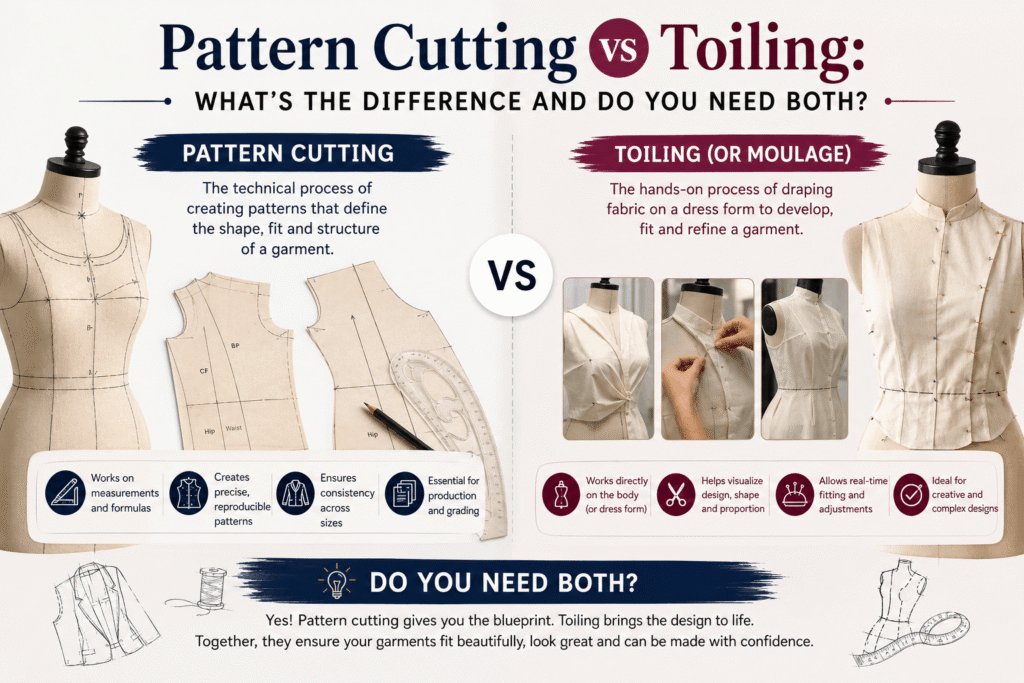
What is pattern cutting is covered in full in the first post in this series. The short version: it is the process of turning a design brief into a set of precise, marked templates — the pattern — that allow a garment to be cut from fabric and assembled consistently.
As covered in our guide to what does a pattern cutter do, creating these templates accurately involves a deep understanding of fabric behaviour, body shape, ease distribution, and construction — it is creative and technical work in equal measure.
The result of pattern cutting is the base pattern. In one size. Ready to be tested.
What is toiling?
A toile — pronounced “twall,” and called a muslin in US industry practice — is a test garment made from inexpensive fabric, usually calico (a plain, unbleached cotton), to check the fit, balance, and construction of the pattern before any expensive fabric is cut.
It is the quality control stage for the pattern. The toile is made from the pattern pieces, assembled in the same way the finished garment will be, and then tried on a fit model or dress stand. The pattern cutter — and ideally the brand founder — assesses the garment carefully. Does the shoulder sit correctly? Is the armhole the right depth? Does the side seam hang straight? Is the silhouette reading as the design intended?
Any corrections identified during the toile fitting are made directly to the pattern — not to the toile, which is discarded. The corrected pattern then moves forward to the sample stage.
How pattern cutting and toiling work together
The relationship between the two services is sequential and complementary. Pattern cutting comes first — it creates the template. Toiling comes second — it tests the template before expensive fabric is used.
In the development timeline covered in our sketch to garment guide, the sequence looks like this:
- Design and tech pack — The brief is documented.
- Pattern cutting — The pattern cutter drafts the pattern from the brief.
- Toiling — A calico test garment is made. The fitting identifies corrections.
- Pattern correction — The pattern is adjusted. A second toile may be made if corrections are significant.
- Sampling — The approved pattern moves into a sample in the final fabric.
- Sample approval, then grading — As covered in our guide to pattern cutting vs grading, grading follows sample approval.
The toile is the checkpoint between pattern cutting and sampling. It exists specifically to catch the errors that are inevitable in any first draft before those errors cost fabric, machinist time, and sampling fees.
Why the first draft of any pattern almost always needs testing
A first draft pattern is a first draft. It is based on measurements, a design brief, a fabric assessment, and the pattern cutter’s professional judgement — but it has not yet been tested on a body or dress stand. Until that test happens, it contains assumptions. Most will be correct. Some will not.
This is not a reflection on the quality of the pattern cutter. It is a reflection of the fundamental reality of what pattern cutting involves — translating a two-dimensional brief into three-dimensional templates without being able to see the result until something is made.
The difference between an experienced pattern cutter and an inexperienced one is not that the experienced one never needs corrections — it is that the experienced one needs fewer, smaller corrections, and can identify and apply them faster during the toile fitting.
What a toile fitting actually involves
A toile fitting is a structured, technical assessment of how the pattern behaves in three dimensions:
- The toile is constructed. The pattern pieces are cut in calico and assembled in the same way the finished garment will be made.
- The toile is put on. It goes onto a fit model or dress stand. The pattern cutter observes and assesses.
- The assessment focuses on specific technical points: shoulder placement, armhole depth and shape, side seam positioning, bust ease and dart positioning, waist definition and hip ease, silhouette and proportion, collar and facing behaviour, centre front and back positioning.
- Corrections are marked directly. The pattern cutter marks corrections onto the calico — lifting seams, re-pinning edges, adjusting darts.
- Changes are transferred to the pattern. The calico toile is discarded. The corrected pattern moves forward.
The real cost comparison: toile vs sampling round
This is where the economics become very clear.
A toile costs: calico fabric (a few pounds), plus studio time to make and assess it. Total: a fraction of a sampling round.
A sampling round costs: fabric in your final material (potentially expensive), sample machinist time, shipping (if overseas), your time reviewing and documenting corrections. Total: significantly more — often more than two toiles combined.
The critical question is not whether the toile costs money. It is whether the sample round it prevents would have cost more. For most fitted or structured garments, the answer is clearly yes.
When you should always do a toile
- Any fitted or structured garment. Tailored jackets, coats, fitted trousers, fitted dresses, blazers — any garment where fit is central and the relationship between pattern and body is complex.
- New designs with complex construction. Unusual silhouettes, complex collars or necklines, asymmetric construction, or any feature the pattern cutter has not seen in this exact form.
- Garments in expensive or unusual fabrics. Silk, cashmere, technical fabrics, deadstock — the financial argument for toiling is even stronger when the final fabric is costly.
- Any garment that is central to the collection. The hero pieces that define the brand’s identity deserve the additional investment of toiling.
- First-time development for a new brand. When developing a brand block for the first time, toiling is the process through which the block is refined and approved.
When you can reasonably skip the toile
- Very simple relaxed-fit jersey styles. Basic crew-neck tees, relaxed joggers, oversized sweatshirts — where fit is deliberately loose and jersey’s forgiving stretch absorbs small ease errors.
- Repeat or closely adapted styles from an approved block. When developing a close adaptation of an already-approved style, the risk in the new pattern is lower.
- Very low-risk design changes. Minor changes to an existing approved style — a different hem length, a moved pocket — may not need a full toile.
- Very tight timelines where the risk is understood. If timeline pressure makes toiling impossible and you understand and accept the risk, this is a business decision you can make. What you should not do is skip the toile under the belief that the first sample will definitely be right.
How toiling interacts with pattern markings and grain
A toile fitting also serves as a practical check on technical details that matter in the finished pattern.
The grain direction of each piece can be assessed during the fitting. If a piece is twisting or pulling, grain may be a factor. The toile allows the pattern cutter to identify and correct grain issues before they reach the factory.
Pattern markings are also tested — notches that are missing or wrongly positioned become apparent when the machinist tries to align pieces for sewing. Seam allowance inconsistencies can cause the toile to come together incorrectly even before the fitting begins.
In this sense, the toile is not just a fitting test — it is a complete rehearsal of the pattern’s production-readiness.
Toiling and method — does it matter how the pattern was created?
The method used to create the pattern — whether flat pattern cutting or draping — influences the toile process.
For a flat-cut pattern, the toile is straightforward: pattern pieces are cut in calico and assembled. For a draped pattern, calico is often used as the working material for the drape itself — so the “toile” is created as part of the pattern making process.
For brands using CAD pattern cutting and 3D visualisation software, virtual toiling can provide some indication of fit — but a physical fitting on the body remains the definitive check.
How to prepare for a toile fitting
As part of how to brief a pattern cutter and your overall development preparation, the toile fitting works best when you arrive with:
- A fit model or dress stand available. The toile should be assessed on the body it is intended for.
- Your design sketches and references. The fitting is an assessment of how closely the pattern reflects the design intent.
- Time to be present. Your presence at the fitting adds significant value — you can confirm design intent directly, ask questions about corrections, and build your development knowledge.
Summary
Pattern cutting creates the template. Toiling tests it. The two services are not alternatives — they are sequential stages of the same development process, each making the other more effective.
For most startup brands developing their first collection:
- Fitted and structured garments should always be toiled
- New designs with complex construction should always be toiled
- Garments in expensive fabrics should always be toiled
- Simple relaxed jersey styles can potentially go straight to sampling
- Adapted styles from approved blocks can sometimes skip the toile
The cost of a toile is always less than the cost of the sample round it prevents.
Developing a collection and want to talk through which styles need a toile? Book a free consultation with A Pattern Cutter →
Frequently Asked Questions
How many toile rounds should I expect? For most garments, one toile followed by corrections is sufficient. For complex or highly structured garments, two rounds are not uncommon. An experienced pattern cutter minimises the number of rounds needed by producing a well-drafted first pattern.
Can the toile fabric be used as the final pattern? In professional brand development, the standard approach is to transfer all corrections to the paper or digital pattern and use the toile as a reference, not as the pattern itself. Calico distorts over time in ways that can introduce errors.
What is the difference between a toile and a sample? A toile is a test garment in inexpensive fabric to test the pattern. A sample is made in the final fabric, with all trims and finishes, to confirm the pattern is approved and the garment matches the design intent. The toile is a fitting test; the sample is a production standard confirmation.
Can I attend the toile fitting? Yes — and you should, particularly for your first season. Being present allows you to confirm design intent directly, see what corrections are being made, and understand the technical decisions behind each adjustment.
What if I skip the toile and the sample comes back wrong? You commission a corrected sample, which costs additional fabric, machinist time, and shipping. If the correction requires significant pattern reworking, you may need two or three additional samples. In most cases, these additional rounds cost more than the toile would have — often significantly more.
This post is part of the Pattern Cutting 101 series from A Pattern Cutter — a pattern cutting, grading, toiling, and sampling studio based in North London, working with fashion startups and growing brands.