
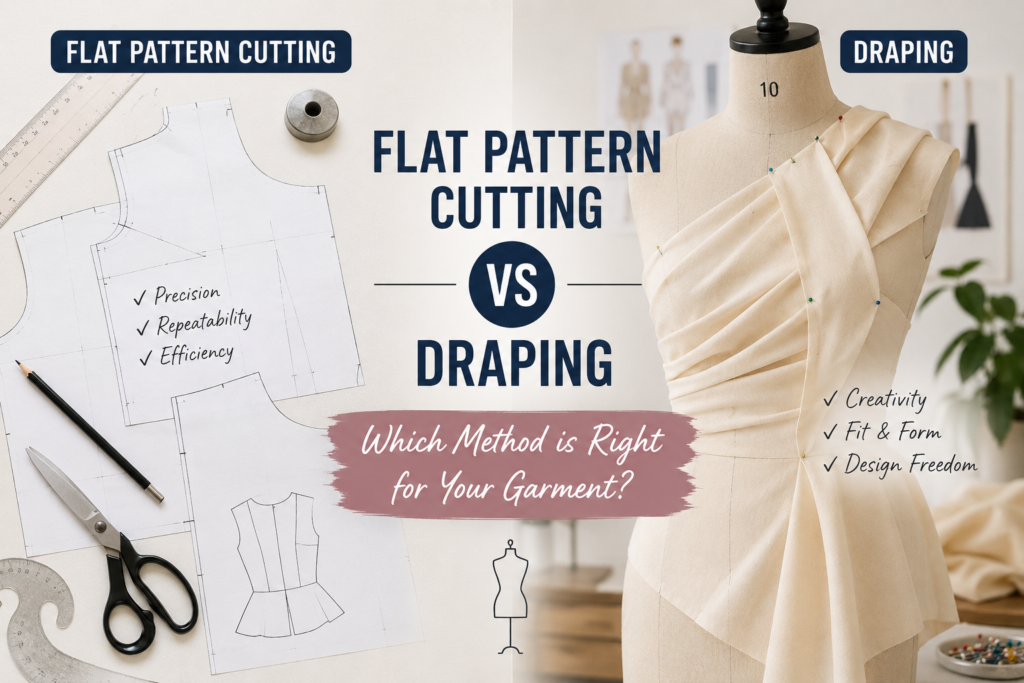
When you hand a design brief to a pattern cutter, one of the first decisions they make — before a single template is drafted — is which method to use to create your pattern.
Most brand founders never think to ask about this. It feels like an internal technical decision, a detail for the studio to handle. And in one sense, it is. An experienced pattern cutter will reach for the right method instinctively, based on the garment, the fabric, and the design intent.
But understanding the difference between the two main approaches — flat pattern cutting and draping — helps you have a more informed conversation with your development team. It helps you understand why some garments take longer to develop than others. And it helps you ask the right questions if a pattern is not behaving the way you expected.
This guide explains both methods clearly, compares them honestly, and gives you a practical framework for understanding which approach is likely to be used on your garments — and why.
First — a quick reminder of what pattern cutting actually is
If you are new to garment development, it helps to have the foundation in place before comparing methods. What is pattern cutting is covered in full in the first post in this series. The short version: pattern cutting is the process of creating the precise, flat templates that allow a garment to be cut from fabric and assembled consistently. The method used to create those templates is what this post is about.
Method one: flat pattern cutting
Flat pattern cutting — sometimes called block manipulation or flat pattern drafting — is the most widely used method in the UK garment industry. It is the standard approach in most professional studios, and the method you are most likely to encounter when working with a London-based development team.
How it works
The pattern cutter works on a flat surface — paper, card, or a digital screen — using a pattern block as the starting point. As covered in our guide to what is a pattern block, a block is a foundational, unstyled template built to your brand’s measurements. The pattern cutter takes this block and manipulates it to create the new style.
The manipulation involves moving seams, introducing style lines, adding darts, rotating dart positions, slashing and spreading pieces to add volume, and reshaping edges — all on a flat surface, in two dimensions, while mentally modelling how each change will behave on the three-dimensional body.
Once the pattern pieces are drafted, they are labelled with grain lines, notches, seam allowances, and construction notes, then used to make a toile (test garment) that confirms the fit.
What flat pattern cutting is best for
Flat pattern cutting is particularly well suited to:
Structured garments. Tailored jackets, coats, trousers, fitted dresses, and woven tops are all designed to hold a specific shape. Flat pattern cutting gives the pattern cutter precise control over every measurement, seam, and proportion — which is exactly what structured garments require.
Jersey and stretch fabrics. Counterintuitively, jersey and knitwear are also typically developed using flat pattern cutting. The stretch properties of the fabric are factored into the ease calculations, and the pattern is drafted accordingly. Draping jersey rarely gives reliable results because the fabric’s behaviour in three dimensions is highly dependent on the garment being worn — not draped over a stand.
Production-focused development. Flat patterns are clean, precise, and easily reproducible. They can be graded accurately, stored digitally, and handed to any factory with confidence. For brands planning to produce at scale, flat pattern cutting gives the most production-ready output.
Repeat styles and seasonal collections. When a brand is developing multiple styles from the same block, flat pattern cutting allows the pattern cutter to work efficiently — adapting the same foundational template rather than starting from scratch for each style.
The advantages of flat pattern cutting
- High precision — every measurement is controlled and documented
- Faster to grade into a size range once the base pattern is approved
- Easier to share with factories in digital format (DXF, PDF, AAMA)
- Consistent results that can be reproduced identically by different factories
- Faster development time for experienced pattern cutters working within a familiar block system
The limitations of flat pattern cutting
- Requires mental translation from 2D to 3D — less experienced pattern cutters can misjudge how a flat shape will behave on the body
- Complex asymmetric or sculptural designs can be difficult to express accurately in flat
- For very fluid or unusual fabrics, it can be hard to predict exactly how the finished garment will drape from a flat pattern alone
Method two: draping
Draping — also called modelling on the stand, or moulage in French — is the process of creating a pattern by working directly with fabric on a dress stand or fit model. Rather than starting on paper, the pattern cutter pins, folds, and shapes fabric in three dimensions until the desired silhouette is achieved, then transfers those shapes onto paper to create the final pattern pieces.
It is a more tactile, visual, and in some ways more intuitive approach — and it produces results that can be difficult or impossible to achieve through flat drafting alone.
How it works
The pattern cutter begins with lengths of calico (or sometimes the final fabric) draped over a dress stand. Working by eye and by hand, they pin and shape the fabric — folding tucks, pinning seams, sculpting volume — until the three-dimensional form of the design is achieved.
Once satisfied with the silhouette, they mark the fabric directly — noting seam lines, grain lines, and construction points — and remove it from the stand. The fabric pieces are then flattened, traced onto paper, and refined into a set of pattern pieces that can be used to make a toile and eventually a sample.
What draping is best for
Draping is particularly well suited to:
Fluid and bias-cut designs. When the finished look depends on how fabric falls, flows, and gathers — evening wear, silk blouses, bias-cut dresses, draped cowl necklines — draping allows the pattern cutter to work with gravity and fabric behaviour in real time. The result often captures a fluidity that is hard to predict from a flat pattern.
Sculptural and asymmetric silhouettes. When the design has complex three-dimensional shaping — dramatic volume, unusual silhouettes, asymmetric construction — draping allows the pattern cutter to see and feel the design taking shape, rather than trying to calculate it from flat.
Couture and bespoke garments. In high-end fashion and bespoke tailoring, where the garment is being made for one specific person and perfection of line is paramount, draping directly on or for that person’s body gives results that flat cutting cannot easily replicate.
Unusual or difficult fabrics. Some fabrics behave in ways that are genuinely unpredictable on paper — very lightweight silks, heavily textured fabrics, unusual weaves. Draping them on the stand gives a real-time view of how they will behave in the finished garment.
The advantages of draping
- Works with fabric behaviour and gravity directly — no need to predict in 2D
- Better suited to fluid, sculptural, or asymmetric designs
- Allows the pattern cutter to see the silhouette taking shape in real time
- Can reveal construction solutions that would be difficult to reach through flat drafting
- The resulting patterns often have a distinctive fluidity in the finished garment
The limitations of draping
- More time-consuming than flat pattern cutting
- Requires a high level of experience and spatial judgement to execute well
- Results can be harder to reproduce exactly — slight variations in how the fabric is pinned produce different outcomes
- Draped patterns are more complex to grade accurately, particularly if pieces have unusual shapes
- Requires fabric and a properly padded dress stand, adding to studio costs per project
How do pattern cutters actually choose?
Here is the honest answer: experienced pattern cutters do not think of it as a strict either/or choice. They use both methods — sometimes within the same garment — and they choose the approach that best serves each part of the design.
A tailored jacket, for example, might be almost entirely flat-cut — the body, sleeves, and collar drafted precisely on paper. But the lapel roll line, or the way the collar sits at the back neck, might be refined on the stand by draping calico over the drafted body. The flat cut gives the precision; the draping gives the refinement.
A bias-cut silk dress might be largely draped — the body and flow of the fabric shaped on the stand — but the lining, facings, and structural pieces might then be drafted flat to ensure they can be graded and produced cleanly.
This is part of what a pattern cutter does that often goes unseen: the constant, instinctive movement between methods, tools, and approaches that produces patterns which are both technically correct and faithful to the design.
What this means for your brand in practice
As a brand founder, you do not need to specify which method your pattern cutter should use. That is their decision to make, based on your garment. But there are a few practical things worth knowing.
Most of your collection will be flat-cut
For the vast majority of startup brand collections — casualwear, contemporary womenswear, menswear, jersey basics, structured separates — flat pattern cutting will be the primary method. It is faster, more precise for production purposes, and produces patterns that can be graded and shared with factories without complication.
Draping capability matters for specific categories
If your brand’s aesthetic leans toward fluid silhouettes, evening wear, draped womenswear, or garments where the fall of the fabric is central to the design, it is worth checking that your development studio has genuine draping experience — not all studios offer it, and not all pattern cutters are equally skilled at it.
Ask directly: have they worked on similar garments using draping? Can they show examples? A pattern cutter who is skilled in flat cutting but has limited draping experience will struggle with a bias-cut evening gown — and that is important to know before development begins.
Digital pattern cutting is a third option worth knowing about
CAD (computer-aided design) pattern cutting is increasingly used alongside both methods. It allows patterns to be created, stored, and shared digitally, and is particularly useful for brands manufacturing overseas or working with large size ranges. We cover CAD in detail in the next post in this series.
Side-by-side comparison
| Flat pattern cutting | Draping | |
| Works from | Block/measurements on paper | Fabric on dress stand |
| Best for | Structured, woven, jersey styles | Fluid, sculptural, bias-cut styles |
| Speed | Generally faster | More time-consuming |
| Precision | Very high | High, but more variable |
| Grading | Straightforward | More complex |
| Factory readiness | Immediately production-ready | Requires translation to flat pattern |
| Skill required | High | Very high |
| Typical use | Most commercial garment categories | Evening wear, couture, unusual silhouettes |
Questions to ask your pattern cutter
When you begin working with a new studio on a collection, these questions will help you understand their approach:
“Which method will you use for this garment, and why?” A good pattern cutter will have a clear answer, explained in plain language.
“Do you have experience draping?” If your collection includes fluid or sculptural pieces, this is worth establishing upfront.
“At what point in the process will you make a toile?” Whether the pattern is flat-cut or draped, a toile (test garment in calico) should be made before expensive fabric is cut. Confirm when this happens.
“Will I receive the final pattern in digital format?” If you are manufacturing with a factory that uses digital files, confirm this is possible regardless of which method is used to create the pattern.
At A Pattern Cutter, our North London studio works with both flat and draped methods, and our team has specific experience in womenswear, menswear, and specialist categories including maternity, plus-size, and tailored garments. We choose the method that best serves your design — and we explain our reasoning clearly at every stage.
Frequently Asked Questions
Is one method better than the other? Neither is universally better. Each is better suited to different garment types, fabrics, and design intents. Flat pattern cutting is the industry standard for most commercial garment categories. Draping is essential for specific design aesthetics. The best studios use both.
Will using draping make my garments more expensive to develop? Potentially, yes — draping is more time-consuming, which typically means higher studio costs per style. It also uses more fabric (calico for the draping process). For garments where draping is genuinely necessary, the additional cost is worth it. For garments that can be flat-cut, using draping adds cost without benefit.
Can a draped pattern be graded into a size range? Yes, but it requires more careful work. Draped patterns often have more irregular shapes than flat-cut patterns, which makes grading more complex. The pattern cutter will typically clean up and regularise the pieces after draping before the pattern is ready for grading.
My factory says they will create the patterns — which method will they use? Most factories use flat pattern cutting, typically working from their own standard blocks. This is one of the reasons factory-made patterns often do not match the designer’s original intent — the factory’s blocks may not reflect your brand’s target proportions, and their flat-cut patterns may not capture the design details of fluid or draped styles.
Does draping require a specific type of dress stand? Yes — the dress stand needs to be padded to match your target customer’s measurements as closely as possible. A standard off-the-shelf stand will produce patterns that fit the stand, not your customer. At A Pattern Cutter, our stands are set up to match each brand’s target proportions.
This post is part of the Pattern Cutting 101 series from A Pattern Cutter — a pattern cutting, grading, toiling, and sampling studio based in North London, working with fashion startups and growing brands.