
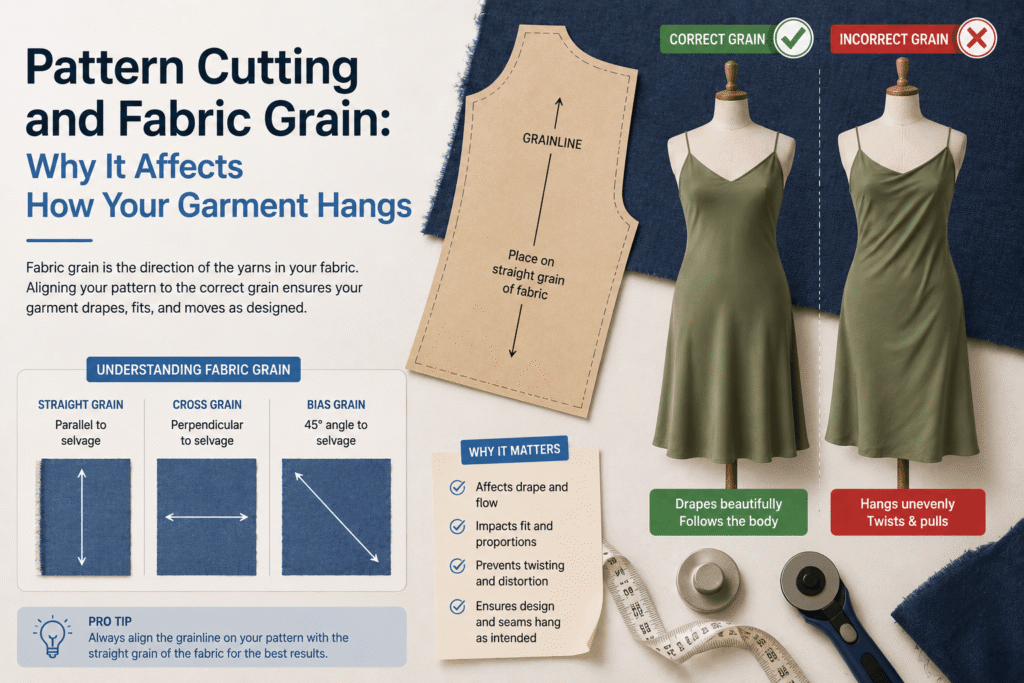
A garment can be sewn perfectly. The seams can be clean, the stitching straight, the construction exactly as specified. And it can still hang wrong.
It twists slightly to one side when worn. The side seam spirals forward on the body instead of sitting at the hip. The collar does not lie flat — one side sits up, the other falls down. The trouser leg turns inward with every step. You inspect it, you re-inspect it, and you cannot find a construction error because there isn’t one.
In almost every case, the cause is fabric grain.
Grain is one of the most technically fundamental aspects of garment production — and one of the least understood by brand founders entering the industry for the first time. It is invisible in a sketch, invisible in a tech pack, and invisible to anyone who does not know what to look for in a finished garment. But it determines, more than almost any other single factor, whether your garment hangs the way you designed it to.
This guide explains what fabric grain is, why it matters so profoundly to what is pattern cutting, how grain decisions are made and communicated through a pattern, and — most practically — how to spot grain problems in your samples before they reach production.
What is fabric grain?
To understand grain, you need to understand how woven fabric is constructed.
A woven fabric is made by interlacing two sets of threads at right angles to each other. The threads running lengthwise — parallel to the long edge of the fabric bolt, known as the selvedge — are called the warp. The threads running across the width, from one selvedge edge to the other, are called the weft.
The grain of a fabric describes the direction and orientation of these threads. There are three grain directions that matter in garment production:
Straight grain (warp grain)
The straight grain runs parallel to the selvedge — lengthwise down the fabric bolt. It is the most stable direction in a woven fabric. Warp threads are typically tighter, stronger, and less prone to stretching than weft threads.
Garment pieces cut on the straight grain hang vertically and hold their shape well through repeated wear and washing. The majority of pattern pieces in any collection are cut on the straight grain — bodice fronts and backs, sleeves, trousers, and most structural pieces.
Cross grain (weft grain)
The cross grain runs at 90 degrees to the selvedge — across the width of the fabric. It has slightly more give than the straight grain because weft threads are generally woven with a little more flexibility.
Some pattern pieces are deliberately cut on the cross grain — waistbands, for example, are often cut cross-grain to take advantage of the slight give and reduce the stiffness of the finished band.
Bias grain
The bias grain runs at 45 degrees to both the straight grain and the cross grain. It is the most fluid, stretchy, and flexible direction in a woven fabric — because at 45 degrees, the diagonal cuts across the interlacing of both warp and weft threads simultaneously, allowing maximum movement between them.
Fabric cut on the bias drapes differently from the same fabric cut on the straight grain. It clings more closely to the body, falls in softer, more fluid folds, and moves with the wearer in a way that straight-grain cutting cannot replicate. As discussed in our guide to flat pattern cutting vs draping, bias cutting is particularly associated with draped garment construction — fluid evening wear, sculpted womenswear, and designs where the natural movement of fabric is central to the aesthetic.
How grain is communicated through pattern markings
The grain direction of each pattern piece is communicated through the grain line — the long arrow marked on every pattern piece that tells the factory cutter how to position that piece on the fabric.
As covered in our guide to pattern markings in fashion, the grain line is arguably the most important marking on any pattern piece. When the factory cutter lays a pattern piece on fabric, they align the grain line arrow parallel to the selvedge of the fabric before marking and cutting.
Every grain line marking on every pattern piece is a deliberate technical decision. That is part of what a pattern cutter does that goes largely unseen from the outside — the constant, precise management of grain throughout the pattern development process.
Why grain matters for how your garment hangs
The practical consequences of grain decisions — and grain errors — are most visible in the finished garment on the body.
Twisted seams
The most common and most visible grain error in production is twisted seams. When a pattern piece is cut even slightly off grain — the grain line not quite parallel to the selvedge — the piece carries tension in the wrong direction. That tension manifests as a seam that twists to the front or back of the body rather than sitting straight at the side.
A twisted side seam on a pair of trousers is one of the clearest signs of off-grain cutting. The trouser leg spirals inward with each wash and wear cycle, eventually pointing clearly to one side. It cannot be corrected by re-pressing or re-sewing. The piece was cut wrong and the problem is permanent.
Uneven hems
On skirts, dresses, and any hemmed garment, off-grain cutting manifests as hems that appear level when laid flat but rise or fall unevenly when the garment is worn and the fabric settles under gravity according to its true grain.
Collars and facings that will not lie flat
Collars, neckline facings, and lapels are particularly sensitive to grain. A collar cut with the wrong grain orientation will pull upward on one side and fall away from the neck on the other. A neckline facing cut incorrectly will roll to the outside of the garment rather than sitting flat inside. These are grain errors, not pressing errors — and no amount of steaming will permanently fix them.
Garments that change shape after washing
One of the most insidious grain problems is the garment that looks acceptable when it leaves the factory but changes shape significantly after its first wash. When fabric is cut off-grain, the threads are under tension in the wrong direction. That tension is temporarily held in place by construction — but when the garment is washed, the tension releases, and the fabric settles back toward its true grain.
For a brand, this is a customer returns and complaints problem — and it is entirely preventable if grain is managed correctly in the pattern and in the cutting room.
Why factories sometimes cut off-grain — and what to do about it
Off-grain cutting is not always an error. Sometimes it is a deliberate production decision driven by fabric efficiency.
When pattern pieces are laid on fabric for cutting — a process called marker making — the goal is to arrange the pieces as tightly as possible to minimise fabric waste. Tilting a piece slightly off-grain allows it to fit into gaps in the marker that straight-grain placement cannot reach — saving a few centimetres of fabric per garment.
In high-volume production, those centimetres add up. For the brand, those savings come at the cost of garments that do not hang as designed.
What to include in your factory brief about grain
When handing patterns to a factory — particularly an overseas factory — include explicit written instructions about grain tolerance. A professional instruction might read:
“All pattern pieces must be cut within 1mm of the marked grain line. Off-grain cutting to improve marker efficiency is not permitted. The grain line on each piece represents a non-negotiable production standard.”
This instruction, combined with a quality control check on the first cut of a production run, protects your garments from the most common form of cost-driven quality compromise.
As part of how to go from sketch to garment, the factory brief and documentation pack is the stage where this instruction belongs. It is as important as the seam allowance specification and the construction notes.
Grain in different fabric types
Woven fabrics
In woven fabrics — cotton, linen, wool, silk, polyester wovens — grain is highly visible and its effects on the finished garment are significant and predictable. Straight-grain pieces hang vertically and hold their shape; off-grain pieces twist and pull. The grain line on every piece of a woven garment is critical.
Jersey and knit fabrics
Jersey and knit fabrics are constructed differently from wovens — they are looped rather than woven — and the concept of grain in knits is sometimes described as “direction of greatest stretch” rather than warp and weft. For most jersey garments, the key grain decision is whether the stretch runs horizontally around the body or vertically. This is encoded in the grain line on each pattern piece.
For stretchy fabrics, the grain line works in conjunction with the ease calculations — what is pattern cutting for stretch fabrics involves building negative ease that only works correctly when the stretch direction is aligned as the pattern intends.
Bias-cut garments
Bias-cut pieces are marked with grain lines at 45 degrees to the straight grain. The factory cutter must position these pieces at the correct angle — a more demanding task than straight-grain cutting, because there is no selvedge to align against directly.
Patterned and striped fabrics
For fabrics with visible patterns, stripes, or checks, grain takes on an additional visual dimension. The pattern in the fabric should match across seams — stripes should continue from front panel to back panel without a visible step. This requires not only correct grain alignment but also careful matching during marker making and cutting.
How to check for grain problems in your samples
As part of reviewing a sample, grain quality is worth checking specifically:
- Put the garment on and observe from the front. Are the side seams sitting at the side of the body, or are they rotating forward or backward? Any rotation indicates off-grain cutting.
- Check the centre front and centre back. On any garment with a centre seam or feature, check that it sits vertically down the centre of the body.
- Check collars, facings, and lapels flat. A collar that lies flat on a table but will not sit correctly on the garment has usually been cut incorrectly.
- Hang the garment overnight, then check the hem. A garment hung overnight will settle to its true grain. If one section drops lower than another, investigate the grain direction.
- Wash the sample once and re-inspect. The washing test reveals grain tension that may be held in place during initial inspection. Any significant change in shape after washing points to a grain issue.
How grain decisions are made during pattern cutting
Grain decisions are not incidental — they are integral to the how to brief a pattern cutter conversation and the pattern development process.
When you provide your fabric to the pattern cutter at briefing stage, they will assess the grain direction, the stretch properties, and how those properties should be factored into the pattern. For complex designs — particularly those involving bias cut or mixed grain directions — the grain decisions may involve a detailed conversation before drafting begins.
For brands working with CAD pattern cutting, grain lines are encoded digitally within each pattern piece file. When patterns are sent to a factory in DXF or AAMA format, the grain lines are included and should be clearly visible on every piece.
Summary — what brand founders need to know about grain
Grain is not a finishing detail. It is a foundational technical decision that shapes how every piece of fabric in your garment behaves — how it hangs on the body, how it moves with the wearer, how it holds its shape through wear and washing.
Protect those decisions by:
- Ensuring every pattern piece carries a clearly marked grain line — confirmed when you review patterns before factory handover
- Including explicit grain tolerance instructions in every factory brief
- Checking grain quality specifically when reviewing samples — not just fit and construction
- Testing samples through at least one wash cycle before approving for production
These steps cost nothing beyond attention and take nothing beyond a clear, consistent briefing process. The garments they protect are worth every moment of that attention.
Want patterns where every grain decision has been made correctly from the start? Book a free consultation with A Pattern Cutter →
Frequently Asked Questions
What is the difference between grain and grain line? Grain refers to the directional structure of the fabric itself — the orientation of the warp and weft threads. Grain line refers to the marking on a pattern piece that communicates how the piece should be positioned on the fabric. The grain line on the pattern is how the pattern cutter’s grain decisions are communicated to the factory cutter.
My garment looks fine when I try it on — do I still need to worry about grain? Yes, if you have not yet washed or worn the garment extensively. Grain tension in a freshly made garment can be temporarily masked by pressing and construction. After washing, the tension releases and grain errors become visible. Always test-wash a sample before approving for production.
Can grain errors be corrected after production? No — not in a practical sense. Once a piece is cut off-grain, the tension is built into the fabric and cannot be removed by pressing, steaming, or re-sewing. The only correction is to re-cut the piece correctly. Prevention through correct grain lines and clear factory briefing is the only viable approach.
Is bias cutting more expensive? Yes, in most cases. Bias-cut pieces use significantly more fabric than straight-grain pieces because they cannot be packed as efficiently on the marker. They also take more time to cut and sew correctly. For garments where bias cutting is central to the design, the additional cost is justified.
Does grain affect jersey and stretch fabrics the same way as wovens? The principles are the same but the consequences differ slightly. Jersey and knit fabrics are more forgiving of small grain errors because their structure allows more movement. However, significant grain errors in jersey still produce twisted seams and garments that change shape over time. The stretch direction encoded in the grain line is particularly important for fitted jersey styles.
This post is part of the Pattern Cutting 101 series from A Pattern Cutter — a pattern cutting, grading, toiling, and sampling studio based in North London, working with fashion startups and growing brands.