
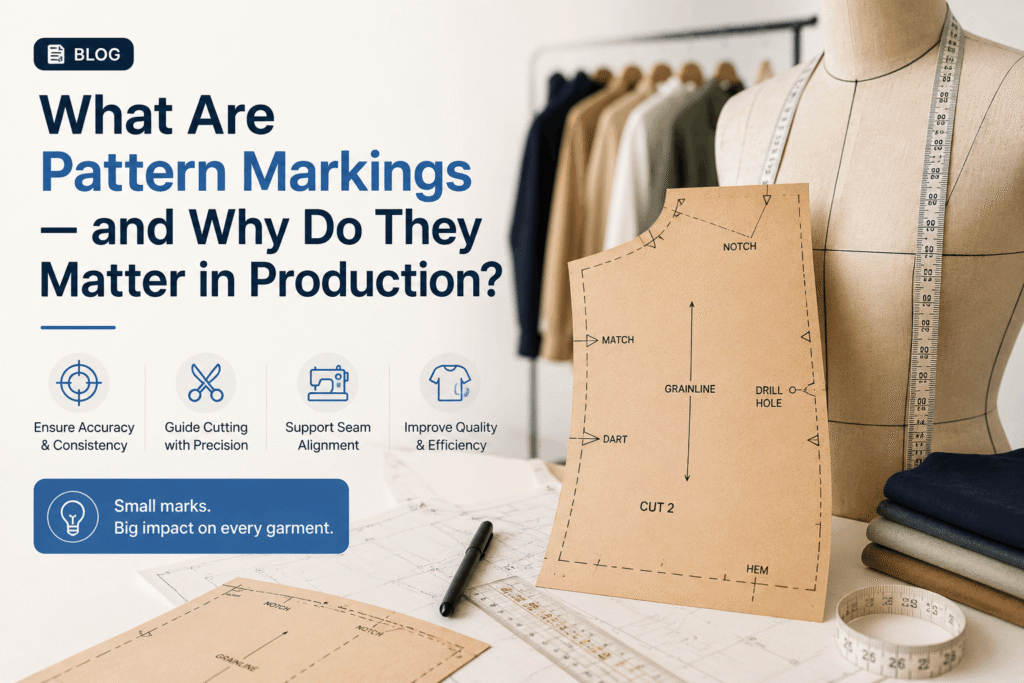
When a set of patterns arrives from your development studio — whether as physical paper pieces or as digital files — they contain far more information than just the outline shape of each garment piece. Every pattern piece is covered in lines, symbols, arrows, notches, and labels. Together these make up the pattern markings: the technical language through which a pattern cutter communicates everything a machinist or factory needs to cut and construct your garment correctly.
As a brand founder, you do not need to be able to draw pattern markings yourself. But understanding what they are — what each one means and why it exists — gives you the ability to review patterns intelligently, spot when something is missing, and have more informed conversations with your studio and factory.
This guide explains every key pattern marking used in professional UK garment production, clearly and plainly — from the perspective of a brand founder receiving and using patterns, not from the perspective of someone learning to sew at home.
Why pattern markings matter so much in production
Before we go through each marking individually, it is worth understanding the stakes.
When a pattern lands in a factory cutting room, the cutter — the person who lays the pattern pieces on fabric and cuts around them — is not the designer. They are not the pattern cutter who created the templates. They may not speak the same language as you or your studio. They work quickly, across multiple brands simultaneously, and they rely entirely on the information encoded in the pattern pieces to make every cutting and assembly decision correctly.
If a marking is missing, they will make a judgement call. If a marking is ambiguous, they will interpret it as they see fit. If a marking contradicts the tech pack, they will follow one and ignore the other — and you may not know which until the production run arrives.
Understanding what is pattern cutting as a whole process is important. But within that process, the markings on each pattern piece are the primary communication tool between your studio and your factory. Getting them right is part of what a pattern cutter does — and knowing what to check for gives you confidence that your patterns are truly production-ready.
The complete guide to pattern markings
1. Grain lines
The grain line is arguably the single most important marking on any pattern piece. It is a long arrow — running the length of the piece — that tells the factory cutter exactly how to position that piece on the fabric.
Specifically, it tells them how the piece should align with the straight grain of the fabric: the lengthwise threads that run parallel to the selvedge edge of the bolt. When a piece is cut with the grain line running parallel to the selvedge, the fabric’s structure works with the garment — giving it stability, ensuring it hangs correctly, and allowing it to wear well over time.
What happens when grain lines are ignored or misread?
The consequences range from visible to catastrophic. A sleeve cut even a few degrees off grain will spiral around the arm when worn — twisting toward the front or back instead of hanging straight down. A bodice back cut off grain will pull to one side and never press flat. A trouser cut off grain will twist at the leg when worn, regardless of how well it is sewn.
These are not sewing errors. They are cutting errors. They cannot be corrected after the fabric is cut — only by cutting new pieces. In production, off-grain cutting affects every single garment in the run.
Grain line variations to know
- Straight grain — the most common. The arrow runs parallel to the selvedge, indicating the piece should be cut with the fabric’s lengthwise threads running in the direction of the arrow.
- Cross grain — the arrow runs at 90 degrees to the selvedge, indicating the piece should be cut along the fabric’s width. Used occasionally for specific design effects.
- Bias grain — the arrow runs at 45 degrees to the selvedge. Bias-cut pieces are intentionally positioned to use the fabric’s most fluid and stretchy direction. As covered in our guide to flat pattern cutting vs draping, bias cutting requires specific expertise and produces garments with distinctive drape and movement.
What to check: Every single pattern piece should have a clearly marked grain line. No exceptions. If a pattern piece arrives without one, it needs to go back to the pattern cutter for correction before it goes anywhere near a factory.
2. Notches
Notches are small marks on the cut edge of a pattern piece — most commonly indicated as a short perpendicular line, a small triangle, or a V-cut into the edge — that tell the machinist where two pattern pieces should meet and align during construction.
They are the jigsaw connectors of the pattern. When the machinist picks up a bodice front and a sleeve, the notches on the armhole edge of the bodice and the notches on the sleeve cap tell them exactly which points should be matched before sewing begins.
The single/double notch convention
In UK and European industry practice, a standard convention distinguishes front from back:
- Single notch — typically indicates the front of the garment, or the front section of a seam.
- Double notch — typically indicates the back of the garment, or the back section of a seam.
This convention prevents the sleeve being sewn in backwards — a mistake that would otherwise be very easy to make, since the sleeve piece looks similar from both sides.
What to check: All major seam joins should have notches. The armhole and sleeve cap must have matching notches, ideally at multiple points. Any curved or long seam should have balance notches at key points along its length.
3. Seam allowances
Seam allowances are the margins of fabric — beyond the finished edge of the garment — that are sewn into the seams and hidden inside the finished piece. In UK industry, the standard seam allowance is typically 1cm on most seams, with 1.5cm often used on body seams and 2cm or more on areas that may need alteration.
How seam allowances should be marked
There are two approaches, and both are acceptable — but the factory must know which has been applied:
- Allowances included (net-plus): The pattern piece already includes the seam allowance. The factory cuts to the edge of the piece and sews at the specified amount from the edge. This is the most common approach for UK production.
- Allowances not included (net): The pattern piece represents the finished edge of the garment. The factory adds their own seam allowance.
When reviewing a set of patterns, always confirm with your studio which approach has been used — and make sure the factory is given this information explicitly. A mismatch between assumed seam allowances can make every garment in a production run the wrong size.
4. Darts
Darts are shaped markings on a pattern piece that indicate where fabric should be folded and sewn to introduce three-dimensional shape into an otherwise flat piece. They are the primary tool for fitting a garment to the curves of the body — most commonly at the bust, waist, and shoulder in womenswear.
On a pattern piece, a dart is typically marked by:
- Two dart legs — the lines along which the fabric is folded and stitched. The dart legs converge at the dart point.
- The dart point — the tip of the dart, where the stitching tapers to nothing. This is often marked with a dot or a drill hole in the pattern.
- The fold line — sometimes indicated by a central line running from the base to the tip, showing where the fabric fold should sit.
A dart sewn at the wrong angle produces a garment that pulls in the wrong direction. A dart that ends in the wrong position changes the entire fit of the bodice. In production, dart markings must be transferred from the pattern to the fabric so that every machinist can sew them consistently.
What to check: Both dart legs should be clearly drawn. The dart point should be marked with a dot. If multiple darts appear on one piece, each should be separately and clearly marked.
5. Fold lines
Some pattern pieces are not complete pieces — they represent only half of a symmetrical garment section. A fold line marking tells the factory cutter that this edge of the pattern should be placed directly against the folded edge of the fabric. When the fabric is unfolded after cutting, the complete symmetrical piece is revealed.
Fold lines are typically marked with a bracket or a double-headed arrow at the edge — sometimes accompanied by the text “place on fold” or “CF fold” (centre front fold) or “CB fold” (centre back fold).
What to check: If a fold line is present, the factory cutter must know to cut with that edge against the fold — not to cut through both layers and produce two half-pieces. Make sure your tech pack notes which pieces have fold lines.
6. Piece labels and identifiers
Every pattern piece should be labelled clearly enough that anyone picking it up can immediately identify what it is and where it goes. A complete piece label includes:
- Style name or reference number — identifying which garment the piece belongs to.
- Piece name — describing what the piece is: “Front bodice”, “Back yoke”, “Sleeve — left”, “Collar stand”.
- Size — the size this piece belongs to, especially important in graded patterns.
- Quantity to cut — how many times this piece should be cut. “Cut 1” for a single piece, “Cut 2” for a mirrored pair.
- Right or wrong side — some asymmetric pieces must be cut on a specific side of the fabric.
What to check: Before handing any pattern to a factory, check that every piece has a complete label. Unlabelled pieces cause confusion, delays, and incorrect assembly.
7. Balance marks and reference lines
On longer or more complex patterns — particularly coats, tailored jackets, and trousers — additional horizontal reference lines are sometimes drawn across the pattern piece at key body points: the waist, the hip, or the bust.
These balance marks serve as alignment guides during construction, allowing the machinist to check that pieces are being joined correctly before committing to a long seam. Balance marks also help the quality controller check that a garment has been assembled correctly after construction.
8. Construction notes
Beyond the symbols and lines, a well-marked pattern piece may include written construction notes for specific seams, finishes, or assembly sequences that cannot be communicated through symbols alone.
Examples include: “ease sleeve cap between double notches”, “topstitch 6mm from edge”, “press seam open before attaching facing”, “interface before cutting” or “cut in self fabric and lining”.
These notes are not a substitute for a complete tech pack — but they are a useful reinforcement of key construction instructions, placed directly on the relevant pattern piece where the machinist is certain to see them.
What a complete, production-ready pattern looks like
When you receive a set of patterns from A Pattern Cutter — or from any professional development studio — a production-ready pattern should include on every piece:
- A clearly marked grain line
- Notches at all major seam joins
- Seam allowances marked (or a clear note that they are not included)
- Dart markings with both legs and the dart point
- Fold lines where applicable
- A complete piece label (style, piece name, size, quantity)
- Balance marks on complex or long seams
- Any relevant construction notes for that specific piece
If any of these are absent, the pattern is not fully production-ready — and the missing information will eventually surface as a production error, a factory question, or a garment that does not match the approved sample.
How this connects to the rest of your development process
Pattern markings do not exist in isolation. They are the final layer of information added to a pattern after it has been drafted, balanced, toiled, and corrected.
As we cover in our sketch to garment guide, pattern cutting sits at the centre of the development journey — and the quality of the markings on the final pattern is one of the clearest indicators of how thoroughly that process has been executed.
When you are briefing a pattern cutter at the start of your project, it is worth asking directly: what markings will be included on the finished patterns? Will seam allowances be included or net? What format will the patterns be delivered in — and if in CAD digital format, will all markings be correctly encoded in the file?
A studio that can answer these questions clearly and specifically is a studio that takes production-readiness seriously. That matters every time a pattern leaves the studio and goes to a factory floor.
Frequently Asked Questions
What is the difference between a notch and a balance mark? A notch is a mark on the cut edge of a pattern piece indicating where two pieces should align during sewing. A balance mark is a reference point positioned mid-seam or mid-piece, used to check alignment along long or curved seams during construction. Both serve alignment purposes but at different stages of the assembly process.
Do digital CAD patterns include all markings? They should — and a professional CAD pattern cutting service will encode all markings within the digital file. However, not all CAD conversions are equal. If you are receiving digital patterns for the first time, ask your studio to confirm that all markings are included and in the correct format for your factory’s software.
Should seam allowances be included in the pattern or added by the factory? Either approach is used in professional production. What matters is that the approach is explicitly agreed and documented before the pattern goes to the factory. In UK production, patterns with seam allowances already included are most common.
How do I check that my patterns are production-ready before sending them to a factory? Run through the checklist above for every pattern piece in your set. Additionally, compare the patterns against the tech pack — check that the piece names, sizes, and specifications match. If possible, have your studio review the patterns one final time before handover.
What happens if a pattern marking is wrong — not just missing, but incorrect? An incorrect marking is potentially more damaging than a missing one. A missing grain line means the factory must make a judgement call. An incorrect grain line actively directs the factory to cut the piece incorrectly — producing garments that look wrong, hang wrong, or cannot be corrected. This is why reviewing patterns carefully before factory handover is so important.
This post is part of the Pattern Cutting 101 series from A Pattern Cutter — a pattern cutting, grading, toiling, and sampling studio based in North London, working with fashion startups and growing brands.
Book a free consultation → | View our services → | Read the full blog series →