
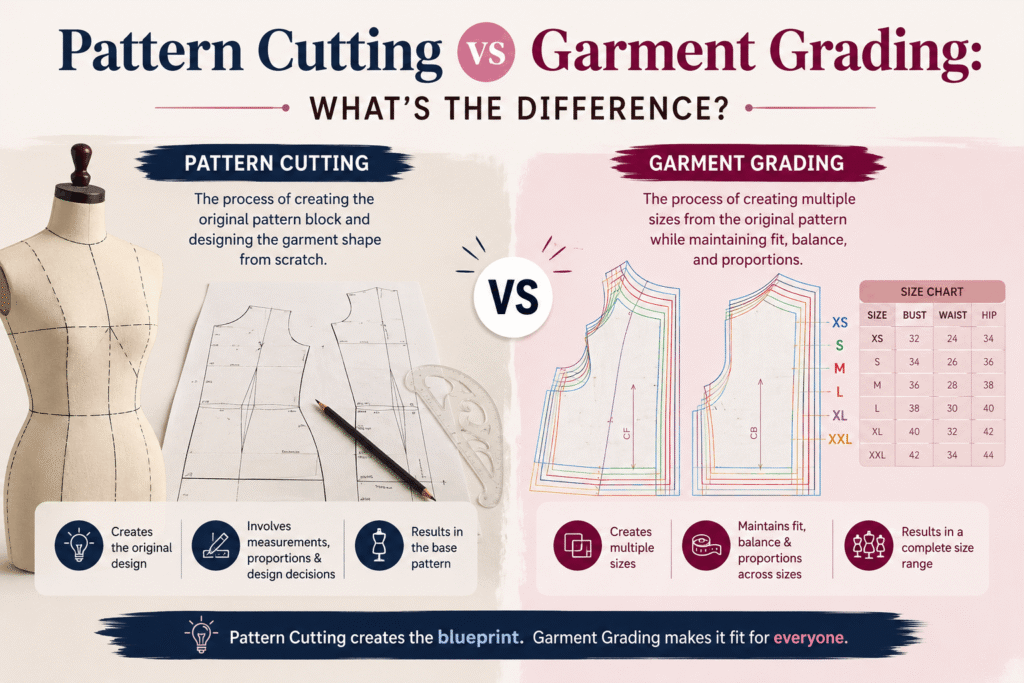
Two terms. Two services. One process that depends entirely on them happening in the right order.
Pattern cutting and garment grading are both essential stages in developing a clothing collection — and they are among the most consistently confused by brand founders working through garment development for the first time. The confusion is understandable. Both services involve patterns. Both are handled by technical specialists. Both happen before production. And in many studios, including ours, both are offered under one roof.
But they are not the same thing. They serve different purposes, happen at different stages of development, and the consequences of confusing them — or, more commonly, rushing grading before pattern cutting is truly finished — are expensive and time-consuming to unpick.
This guide explains both services clearly, compares them directly, and gives brand founders a practical understanding of when each happens, what each costs to get wrong, and how to make sure both are handled in the right order.
What is pattern cutting? A quick recap
What is pattern cutting is covered in full in the first post in this series. The short version: pattern cutting is the process of creating the original pattern for a garment — a set of precise, marked templates, usually in a single size, that allow the garment to be cut from fabric and assembled consistently.
The result of pattern cutting is the base pattern: typically drafted in your sample size (often a UK 10 or 12 in womenswear), refined through toile fittings and sample rounds, and eventually approved as the production standard for that style.
Pattern cutting is creative and interpretive. What a pattern cutter does involves making numerous technical decisions — about ease, proportion, grain direction, seam shaping, construction details — that directly define what the garment looks and feels like.
Pattern cutting produces one approved pattern. In one size. That is the starting point for everything else.
What is garment grading?
Grading is the process of scaling an approved base pattern up and down into a full size range, while maintaining the proportions, fit, and aesthetic balance of the original across every size.
A grader takes your approved size 10 pattern and applies carefully calculated incremental measurements to produce accurate size 6, 8, 12, 14, 16, and 18 versions — or whatever size range your brand offers. Each size increment is calculated at specific points across every pattern piece: the bust, waist, hip, shoulder width, sleeve length, armhole depth, and many others.
The goal of grading is not simply to make the pattern bigger or smaller. It is to produce a garment in every size that fits as well and looks as good as the original approved size — maintaining the design’s proportions, the fit philosophy, and the silhouette across the full range.
The clearest way to understand the difference
If pattern cutting is the creation of the blueprint, grading is the process of printing it in different scales.
A building architect creates one set of detailed drawings for a specific building. A reprographics specialist then produces versions of those drawings at different scales. The architect’s work is creative, technical, and iterative. The reprographics work is precise and systematic. Both are skilled. Both are essential. But they are different kinds of work, done at different times — and the reprographics specialist cannot start until the architect’s drawings are finalised.
That is exactly the relationship between pattern cutting and grading.
The five key differences between pattern cutting and grading
1. What each service creates
Pattern cutting creates the original pattern in a single base size. This is a new piece of work — a design decision encoded in templates.
Grading scales that existing approved pattern into the full size range. This is a systematic expansion of work that already exists.
2. When each service happens in development
Pattern cutting happens early — it is Stage 3 in the development journey covered in our sketch to garment guide. It follows the tech pack and precedes the toile and sample stages.
Grading happens late — after the sample has been approved. It is the penultimate stage before production handover.
3. How many rounds each typically involves
Pattern cutting is iterative. It is normal to go through one or two rounds of toile fitting and sample correction before a pattern is approved.
Grading is typically done once, after the base sample is approved. It is not a stage that involves revision rounds.
4. The nature of the skill involved
Pattern cutting combines technical precision with design interpretation and judgement. The pattern cutter is making decisions about how the garment should look and fit.
Grading is technical and mathematical. The grader is not redesigning the garment — they are applying rules to scale it. The aesthetic decisions were locked in at the pattern cutting stage.
5. Who owns the risk
Pattern cutting carries the creative risk — if the pattern is wrong, the garment will not fit as designed. That risk is managed through toiling and sampling.
Grading carries the execution risk — if grade increments are incorrectly calculated, the size range will not fit proportionally. A size 16 might be well-fitted at the bust but tight at the hip.
Why the order between them matters so much
This is the point that startup brands most consistently get wrong — and the one with the most expensive consequences.
Grading must always happen after the base pattern is fully approved. Not mostly approved. Not “close enough.” Fully, unambiguously approved, with a signed-off sample to confirm the fit.
When a base pattern is graded, the grader applies incremental measurements to every point on every pattern piece — potentially thirty or more pieces for a structured jacket, across every size in the range.
Now imagine a small correction is needed after grading — say, the shoulder seam needs to move 8mm. On the base pattern, that is a fifteen-minute fix to two pieces. After grading across eight sizes, that same correction must be applied to sixteen pattern pieces individually, each requiring the grader to re-check the grade increments.
The lesson: however much timeline pressure you are under, do not begin grading until the base sample is approved.
What grading involves technically
Grade rules and grade points
Grading is governed by grade rules — predetermined measurements specifying how much each key measurement should increase or decrease between each size step. These are applied at specific grade points on each pattern piece.
A typical womenswear grade rule set might specify:
- Bust: increase by 4cm between each size step (2cm per side seam)
- Waist: increase by 3cm between each size step
- Hip: increase by 4cm between each size step
- Shoulder width: increase by 0.5cm per size step
- Sleeve length: increase by 0.5cm per size step
- Back length: increase by 0.25cm per size step
Why grade rules are brand-specific
Standard grade rules exist — industry references developed over decades. But most professional studios develop grade rules specific to each brand, based on the brand’s own size chart, fit philosophy, garment category, and any specialist sizing considerations.
Using a standard grade table without checking it against your brand’s actual size chart is one of the most common grading errors.
Manual vs digital grading
Grading can be done by hand or digitally using CAD pattern cutting software. For brands with wide size ranges — typically six sizes or more — digital grading is significantly more efficient and less prone to human error.
The output format matters too. If your factory uses computerised cutting equipment, they need graded patterns in a digital format — DXF, AAMA, or similar. Confirming the required format with your factory before grading begins saves conversion costs after the fact.
How grading interacts with pattern markings and seam allowances
Pattern markings
As covered in our guide to pattern markings in fashion, every pattern piece must carry a complete set of markings before it is production-ready. When a pattern is graded, all markings are carried through to every graded size. A base pattern missing markings or carrying errors will carry those problems into every graded size.
Seam allowances
As explained in our guide to what is seam allowance, seam allowance inconsistencies in the base pattern become amplified across a graded set. If the side seam of the base pattern carries 1cm on the front and 1.5cm on the back, that mismatch is duplicated eight times across a graded set of eight sizes.
Grain direction
As covered in our guide to fabric grain in pattern cutting, grain direction must be carefully maintained across every graded size. The grain line must be re-evaluated on each graded piece to confirm it still reflects the correct direction relative to the new piece shape.
Can the same studio handle both services?
Yes — and in most cases, this is the more efficient and more reliable approach.
When pattern cutting and grading are handled by the same studio, the grader has direct knowledge of the original pattern: how it was drafted, what decisions were made about ease and grain, where the fit-critical areas are.
At A Pattern Cutter, both services are offered from our North London studio. Whether you need pattern cutting alone, grading alone, or the full journey from brief to production-ready graded set, we handle it in-house.
How to brief a pattern cutter when grading is also required
The decision about grading should be part of your initial briefing conversation. As part of how to brief a pattern cutter, raise the following:
- What size range are you planning? This determines the number of grade steps required.
- Do you have a brand size chart? The grade rules must be built from your brand’s own size chart.
- Does your factory need digital patterns? Confirm this upfront so the studio works in the correct format.
- What is your timeline from approval to production? Building grading realistically into the timeline prevents pressure to start before the base sample is ready.
Summary — the rules every brand founder needs to follow
- Rule 1: Pattern cutting always comes first. Grading always comes second. No exceptions.
- Rule 2: Grading begins only after the base sample is fully approved.
- Rule 3: Confirm the factory’s required format (manual or digital) before grading begins.
- Rule 4: Use grade rules built from your brand’s actual size chart — not a generic standard.
- Rule 5: When possible, have the same studio handle both services.
Ready to talk through your pattern cutting and grading requirements? Book a free consultation with A Pattern Cutter →
Frequently Asked Questions
Can grading fix a pattern that does not fit well in the base size? No. Grading scales a pattern — it does not correct it. A pattern with a fit problem in size 10 will have that same problem, proportionally scaled, in every graded size. The base pattern must be right before grading begins.
How many sizes can a pattern be graded to? There is no fixed limit. In practice, the wider the range, the more important it becomes to check a size set sample to confirm the grades are working as intended.
What is a size set sample? A size set sample is a garment made in every size of the graded range — or at minimum the largest and smallest sizes — to confirm that grading is correct. For any brand offering more than four sizes, a size set sample is a worthwhile investment.
My factory says they can grade for me — should I let them? Factory grading is common, particularly overseas. The quality varies. Some factories apply their own standard grade rules without reference to your brand’s size chart. If you use factory grading, always supply your brand’s size chart as the specification and request a size set sample before production.
Does grading affect the cost of subsequent pattern cutting work? It can. If you return to develop new styles from the same brand block, graded patterns from previous seasons inform but do not replace the new pattern cutting work. The value of graded patterns lies in the consistency they bring to production.
This post is part of the Pattern Cutting 101 series from A Pattern Cutter — a pattern cutting, grading, toiling, and sampling studio based in North London, working with fashion startups and growing brands.