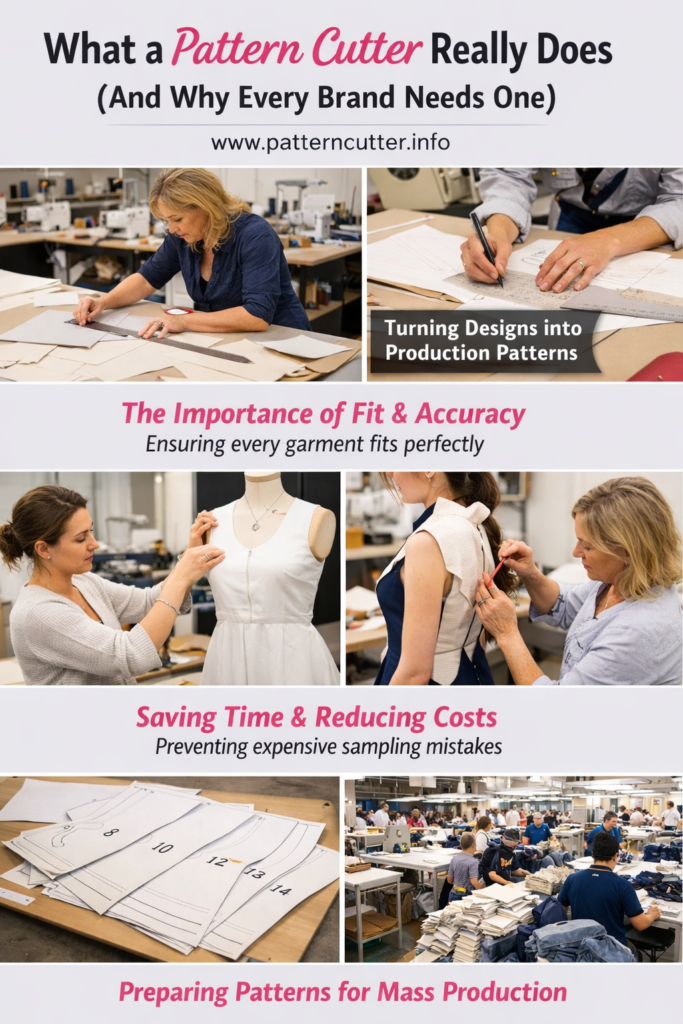
When people think about fashion, they often picture designers sketching beautiful outfits or models walking down a runway. What’s far less visible—but absolutely essential—is the role of the pattern cutter. Behind every well-fitting garment is a skilled pattern cutter translating creative ideas into something that can actually be worn, produced, and sold.
Without one, even the most beautiful design can fail. So what does a pattern cutter really do—and why does every serious fashion brand need one? Turning Design Ideas Into Reality A pattern cutter takes a designer’s concept—whether that’s a sketch, reference image, or rough idea—and turns it into a technical blueprint for a garment.
This involves: Interpreting the design’s shape, proportions, and style Deciding how the garment will be constructed Creating pattern pieces that fit together correctly Ensuring the garment works in real fabric, not just on paper A drawing might look great, but if it can’t be cut, sewn, worn, and repeated consistently, it isn’t production-ready. That’s where pattern cutting bridges the gap between creativity and construction. Fit Is Their Responsibility One of the most important jobs of a pattern cutter is fit.
They consider: Body proportions and movement Ease (how much room the wearer needs to sit, walk, and breathe) Balance and drape How the garment behaves in different fabrics If a garment pulls, twists, gapes, or feels uncomfortable, the issue almost always starts at the pattern stage—not in the sewing. Good pattern cutters think in three dimensions. They understand how a flat pattern becomes a moving, wearable object on a real body.
Saving Brands Time and Money Many new brands underestimate how costly poor pattern cutting can be. A skilled pattern cutter helps brands: Reduce the number of failed samples Avoid production delays Minimise fabric waste Prevent expensive reworking at factory level Bad patterns lead to repeated sampling, confused machinists, inconsistent sizing, and garments that don’t meet expectations. All of that costs money.
Good pattern cutting, on the other hand, creates clear, accurate patterns that factories can follow efficiently—saving time from development through to production. Preparing Garments for Manufacturing Pattern cutters don’t just make patterns for one sample size. They prepare garments for real-world manufacturing.
This includes: Creating production-ready pattern sets Adding seam allowances, notches, and construction marks Working with grading rules to create full size ranges Adjusting patterns to suit different factories or production methods A pattern that works in a studio may not work in a factory. Pattern cutters ensure patterns are practical, repeatable, and scalable. Supporting Designers (Not Replacing Them) A common misconception is that pattern cutters “change” designs.
In reality, they support and protect the designer’s vision. They may suggest: Construction improvements Fabric-appropriate adjustments Small changes that improve fit or durability These aren’t creative compromises—they’re technical solutions that help the garment succeed in the real world. The strongest fashion brands are built on collaboration between designers and pattern cutters.
Essential for Startups and Established Brands Alike Whether you’re launching your first collection or running an established label, a pattern cutter is not optional. Every brand needs one because: Patterns are the foundation of every garment Fit directly affects customer satisfaction and returns Production depends on clear technical information Long-term success relies on consistency and quality A brand can survive without big marketing budgets—but it won’t survive without garments that fit, function, and feel right. Final Thoughts Pattern cutters are the quiet architects of fashion.
Their work isn’t always visible, but it’s felt every time a garment fits perfectly, moves comfortably, and looks exactly as intended. If you’re serious about building a fashion brand—whether small or scaling—investing in professional pattern cutting isn’t a luxury. It’s a necessity.