
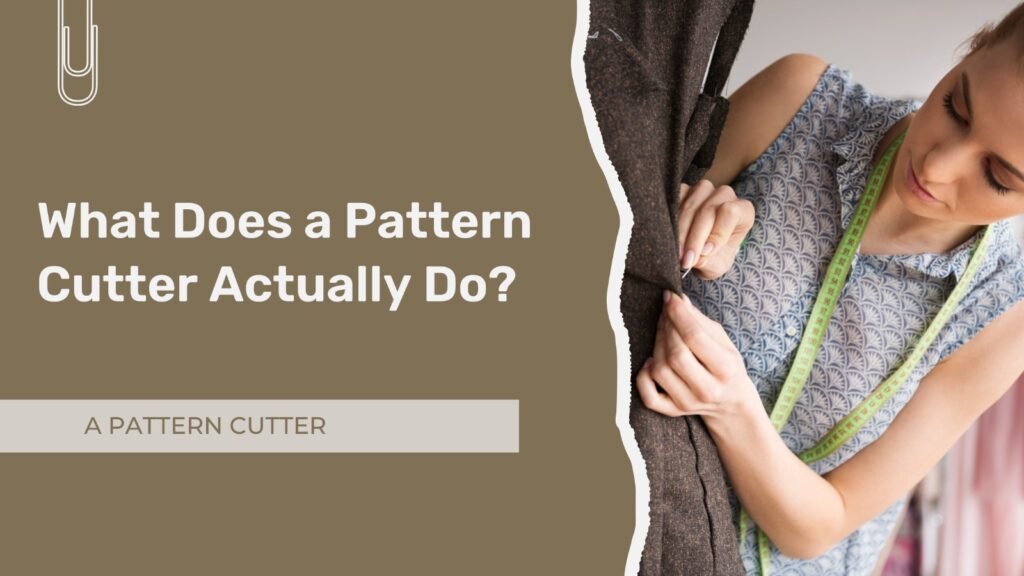
If you are building a fashion brand for the first time, you will quickly encounter a role that sounds self-explanatory — but rarely is. A pattern cutter. They cut patterns. Simple enough.
Except the job is far more involved than the name suggests. A pattern cutter is one of the most technically skilled people in the entire garment development process, and for a startup brand, finding the right one — and understanding what they actually do — can make the difference between a collection that reaches production and one that stalls in an endless cycle of costly corrections.
This guide explains the role clearly, from the inside. What a pattern cutter does every day, what skills the job demands, and — crucially — why your brand specifically needs one before your first garment goes anywhere near a factory.
First — a quick reminder of what pattern cutting actually is
Pattern cutting is the process of turning a design idea into a set of precise, workable templates — called patterns — that allow a garment to be cut from fabric and constructed consistently. If you want to go deeper on this, our guide to what is pattern cutting covers the full picture.
The pattern cutter is the person who creates those templates. But creating them well involves far more than drawing lines on paper.
What a pattern cutter actually does — in plain terms
The simplest way to think about a pattern cutter is this: they are the translator between a design and a garment.
A sketch on paper has no practical value on its own. It is a creative idea, an intention, a visual. The pattern cutter’s job is to take that intention and convert it into something a machinist can sew and a factory can reproduce — accurately, consistently, at scale.
That translation is not mechanical. It requires deep technical knowledge, careful judgement, and a thorough understanding of fabric, body shape, and garment construction. Here is what that looks like in practice.
What a pattern cutter does day to day
1. Reviews the design brief
Before a pattern cutter picks up a pencil or opens their software, they need to fully understand what they are making. This means studying the design sketch, reading the tech pack, examining any reference garments, and having a detailed conversation with the brand founder or designer.
They are looking to understand: the intended silhouette, the fabric the garment will be made in, the target fit (close, relaxed, oversized), and any specific construction details that are central to the design. The more detail they are given at this stage, the fewer assumptions they need to make — and assumptions in pattern cutting lead to corrections later.
2. Drafts the pattern pieces
Working from a block (a foundational template built to the brand’s measurements) or from scratch, the pattern cutter creates each individual piece of the pattern — the bodice, back panel, sleeves, collar, facings, pockets, waistband, and any other components the garment requires.
Each piece is drafted with millimetre precision. Style lines are drawn, darts are positioned, curves are shaped. At this stage the pattern cutter is simultaneously thinking in two dimensions (flat paper) and three dimensions (how this flat piece will behave on a human body). That mental translation — from flat shape to three-dimensional garment — is one of the core skills of the role, and it takes years to develop.
3. Balances the pattern
Once the pieces are drafted, the pattern cutter checks that the pattern is balanced. This means:
- Seam edges that are meant to be sewn together are the same length (or deliberately different, for ease)
- The ease — the extra volume built in for movement and comfort — is distributed correctly across the garment
- The silhouette reads as the design intended when you imagine the pieces assembled
- Style lines sit correctly on the body and are consistent from front to back
An unbalanced pattern produces a sample that pulls, twists, or sits incorrectly on the body — problems that cannot be fixed by better sewing, only by correcting the pattern.
4. Adds all production markings
A pattern piece without markings is not a production-ready pattern. Once the shapes are correct, the pattern cutter adds everything the factory needs:
- Grain lines — showing how each piece must be aligned with the fabric grain
- Notches — small marks indicating where pieces join and how they should align
- Seam allowances — the margin of fabric beyond the sewing line, clearly measured
- Fold lines — showing which edges sit on a fabric fold
- Dart markings — showing the fold direction and taper point
- Labels — piece name, size, front/back designation, and any special construction notes
5. Supervises or attends the toile fitting
Once the pattern is drafted, most professional studios will make a toile — a test garment in inexpensive calico fabric — to check the fit and balance before any expensive fabric is cut.
A good pattern cutter attends the toile fitting and observes the garment directly on the body or dress stand. They watch how seams sit, how the fabric pulls or falls, whether the armhole restricts movement, whether the side seam hangs straight. What they see, they translate back into corrections on the pattern.
6. Makes corrections and refinements
Rarely does a pattern come out perfectly on the first draft — particularly for complex garments or unusual silhouettes. The pattern cutter takes feedback from the toile fitting and works back through the pattern, adjusting the pieces and re-checking the balance.
For a startup brand, this iterative process is where the real value of an experienced pattern cutter shows. Someone who can identify the cause of a fitting problem quickly — and apply the right correction — reduces the number of rounds needed to reach an approved pattern.
7. Prepares the pattern for production handover
Once the pattern is approved, the pattern cutter prepares it for factory handover. This means ensuring every piece is clean and complete, that seam allowances are correct for the factory’s requirements, and that the pattern is in the right format — physical paper pieces, or digital files in DXF, AAMA, or PDF format.
8. Supports grading
Once the base pattern is signed off, the pattern cutter — or a specialist grader — scales it into the full size range. This is a mathematically precise process of applying incremental measurements to each pattern piece to produce consistent, well-proportioned garments across all sizes.
What skills does a pattern cutter need?
The role sits at the intersection of engineering and craft. The best pattern cutters combine:
- Millimetre-level precision. A few millimetres in the wrong place on a shoulder seam, a collar stand, or an armhole can completely change how a garment sits.
- Deep fabric knowledge. The pattern cutter needs to understand how different fabrics behave — how jersey stretches, how silk drapes, how denim holds its shape.
- Body and fit knowledge. Fit is not just about measurements. It is about how the body moves, where it needs ease, and how different silhouettes interact with different body shapes.
- Design interpretation. A sketch is never perfectly precise. The pattern cutter fills in the gaps while staying faithful to the designer’s intent.
- Problem-solving under pressure. A garment that is not fitting correctly needs a pattern cutter who can diagnose the cause quickly and apply the right correction.
- Clear communication. A pattern cutter who can explain technical decisions clearly is far easier to work with and produces better results.
Pattern cutter vs dressmaker vs sample machinist
Three roles that are consistently confused, especially by founders early in their journey.
A pattern cutter creates the templates. They do not sew. Their output is a set of precise, marked pattern pieces.
A sample machinist sews the sample. They take the pattern pieces from the pattern cutter, cut the fabric, and construct the garment to production standards.
A dressmaker makes one-off garments for individual clients, typically to bespoke measurements. Their training and workflow are designed for single, bespoke production — not the repeatable, scalable development that a growing fashion brand requires.
For a fashion brand, you need a pattern cutter and a sample machinist working together. Using a dressmaker for brand development is one of the most common and most costly early mistakes a startup can make.
Why does your brand specifically need a pattern cutter?
As a brand founder, you are not making one garment for one person. You are building a product that must be reproduced hundreds or thousands of times, across multiple sizes, by a factory that has never met you and will work from your documentation alone.
A pattern cutter makes that possible. They create the blueprint that allows anyone in your supply chain to build your garment exactly as you designed it — consistently, every time.
Also Read – What a Pattern Cutter Really Does (And Why Every Brand Needs One)
The cost of getting it wrong
Here is the reality that most startup brands do not hear clearly enough: the pattern is the part of garment development where investing properly saves the most money overall.
A pattern cutter who charges appropriately for their skill and experience will produce a pattern that needs one toile fitting and one or two sample rounds. A cheap or under-skilled pattern cutter will produce a pattern that needs five sample rounds — each one costing fabric, machinist time, and shipping, plus all the delays that come with it.
The pattern is always cheaper to fix before the sample is made than after it.
What to look for when choosing a pattern cutter
Not all pattern cutters have the same experience. Most specialise in specific categories — womenswear, menswear, tailoring, sportswear, lingerie, maternity. When speaking to a studio or freelance pattern cutter, it is reasonable to ask about:
- Their specific experience in your garment category
- Whether they offer toiling as part of the development service
- How they handle corrections and revisions
- What file formats they can supply
- Whether they can support grading once the pattern is approved
- How they communicate with clients throughout the process
Working with A Pattern Cutter
At our North London studio, we work with fashion startups and growing brands at every stage of the development process — from the first briefing conversation through to production-ready patterns, toiles, sampling, and grading.
If you are working on your first collection, or if you have been through a frustrating development process and want to start again with stronger foundations, we would be glad to talk it through.
Frequently Asked Questions
Do I need a pattern cutter if my factory says they can provide patterns?
Some factories offer an in-house pattern service, but the quality varies significantly. Factory-provided patterns are often based on existing blocks that may not match your design or your target customer’s proportions. For a brand that wants to own its fit identity, a dedicated pattern cutter working in your interests is a much stronger foundation.
How do I know if a pattern cutter is experienced enough for my project?
Ask directly about their experience in your specific garment category. Ask to see examples of previous work or to speak to previous clients. A pattern cutter who can answer these questions confidently, with specifics, is likely to have the experience to back it up.
Can a pattern cutter work from a sketch, or do I need a tech pack first?
A skilled pattern cutter can work from a detailed sketch — but a tech pack will always produce better results, because it removes ambiguity. Many studios can help you develop a tech pack as part of the briefing process.
What is the difference between a pattern cutter and a grader?
A pattern cutter creates the original pattern in the base size. A grader scales that approved pattern into the full size range. At A Pattern Cutter, we offer both services under one roof.
How much does a pattern cutter cost?
Costs vary by garment complexity, number of pieces, and whether toiling and grading are included. The most useful thing to do is share your designs and request a specific quote.
This post is part of the Pattern Cutting 101 series from A Pattern Cutter — a pattern cutting, grading, toiling, and sampling studio based in North London, working with fashion startups and growing brands.