
There is one decision in the early life of a clothing brand that quietly determines how well every garment fits for the next several years. Most founders make it without fully realising what it is.
That decision is whether to build your collection on a proper pattern block — or to piece your development together from whatever starting points are available at the time.
The brands that get this right find that each new season flows more smoothly than the last. Their sizing is consistent. Their sampling is faster. Their customers trust the fit and come back for more.
The brands that get it wrong spend season after season chasing fit problems that never quite get resolved — because the foundation was never right in the first place.
This guide explains what a pattern block is, why it matters for a growing clothing brand, and what you need to know before your first collection goes into development.
What is a pattern block?
A pattern block — also called a sloper, or sometimes a master pattern — is a basic, unstyled template that forms the starting point for developing all the patterns in a collection.
It is not a finished pattern. It has no collar, no pockets, no design details. It is simply the core shape of a garment type — stripped back to its essential form — built to fit your target customer’s body.
Think of it the way a builder thinks of foundations. You would not build a row of houses each with its own unique, improvised foundation. You would establish one solid, properly engineered base and build consistently from it. A pattern block is exactly that — the engineered base from which every garment in your range is developed.
To understand why this matters so much, it helps to understand what pattern cutting actually involves. If you are new to the process, our guide to what is pattern cutting covers the full picture clearly.
What does a pattern block look like?
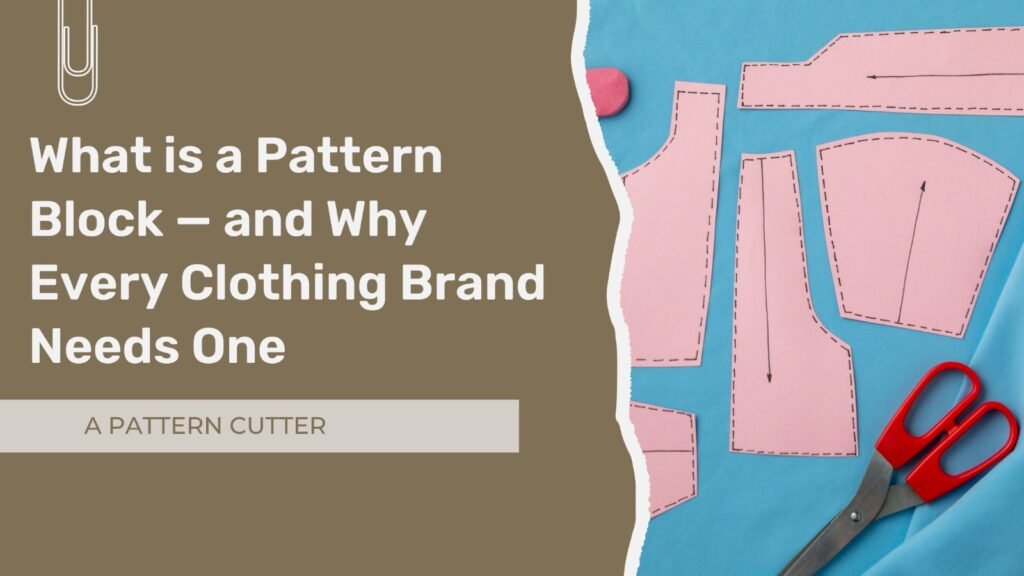
A block is a set of flat pattern pieces — usually on card or in digital format — each representing a core section of the body. The most common blocks in a women’s or men’s womenswear studio are:
- Bodice block — the upper body from shoulder to waist. This is the foundation for tops, dresses, jackets, and coats.
- Sleeve block — drafted to work specifically with the bodice block. Gets the arm from shoulder to wrist, with the right relationship to the armhole.
- Skirt block — waist to hem. The foundation for all skirt styles and the lower half of dress developments.
- Trouser block — waist to ankle, with the seat, crotch, and leg shaped to your target proportions.
- Shirt block — a variation of the bodice with more ease built in, used for more relaxed or functional styles.
Each block contains minimal wearing ease — just enough for the body to move and breathe — with no design ease and no style details. It is the simplest possible version of that garment category, drafted to your specific measurements.
Block vs sloper vs fitting shell — what is the difference?
These three terms cause a lot of confusion, so it is worth separating them clearly.
A fitting shell is a basic pattern used in fashion schools and tailoring to check fit. It is very close to the body with minimal ease. It is a fitting tool, not a production tool, and you would never develop production styles directly from it.
A sloper is a term used primarily in the US fashion industry, and it is often used interchangeably with “block.” In UK practice, “block” is the standard term. Both refer to the same concept — a foundational, unstyled pattern template.
A block in production terms is a working pattern that has been refined through real fittings and approved as the basis for developing new styles. It typically has a little more wearing ease than a fitting shell, and it is a practical tool rather than a theoretical one.
For a UK-based brand, the term you will hear most often in studios, factories, and development conversations is block.
Why does your brand need its own block?
This is the question that matters most for a startup founder. You may have heard pattern cutters or factories talk about working from “existing blocks” — and wondered whether that is sufficient. The honest answer, in almost every case, is no.
Consistency across your whole collection
When every style in your collection is developed from the same block, every style shares the same foundational fit. The shoulder sits in the same place. The armhole is the same depth. The waist falls at the same point. A customer who knows their size in your brand can rely on it working whether they are buying a dress, a jacket, or a pair of trousers.
Without a brand block, each style has its own starting point — perhaps a reference garment for one, a factory sample for another, a fresh draft for a third. Each might fit reasonably well on its own. But they will not fit consistently with each other, because they were not developed from the same foundation.
Faster development every season
Once a block exists and has been approved through fittings, every new style developed from it starts from a known, trusted foundation. The pattern cutter is not starting from scratch — they are adapting and building. That speeds up every development round.
Fewer sampling rounds
Sampling is expensive. Fabric, machinist time, revisions, shipping — each round costs money and time. When a style is developed from an approved block, the base fit is already trusted. The pattern cutter is adjusting style details, not re-solving fit problems. That means fewer rounds are needed before a pattern is ready for production.
Your brand’s fit identity
Over time, your block becomes more than just a technical tool. It becomes the expression of your brand’s relationship with its customer’s body. A good pattern cutter understands this. Part of what a pattern cutter does when developing a brand block is not just hitting measurements — it is encoding your brand’s fit philosophy into a reusable foundation.
Brand block vs bought-in block — which should you use?
When startup brands first ask about blocks, one option that sometimes comes up is buying a standard block from a supplier and using that as the starting point. It is quicker and cheaper upfront. Is it a good idea?
Occasionally, for very early-stage development where the priority is testing a concept quickly rather than building long-term foundations. But as a permanent approach, there are significant limitations.
A bought-in block is built to someone else’s measurements. The sizing conventions, ease allowances, and proportions reflect a generic standard — not your target customer, not your fit philosophy, and not your brand.
A bespoke brand block, built to your target customer’s measurements and refined through proper fittings, is the only real foundation for a brand that takes its fit seriously.
When should you invest in a block?
The simplest answer: before you develop your first collection, if at all possible.
Starting with a block — even if it means a slightly longer lead time at the very beginning — produces stronger, more consistent patterns from your very first style.
How is a brand block created?
A pattern cutter creates your block using the measurements of your target customer — ideally taken from a fit model or dress stand that accurately represents who you are designing for. The process typically involves:
- Taking measurements. Key body measurements are taken — bust, waist, hip, back length, shoulder width, sleeve length, and others relevant to the garment types you are developing.
- Drafting the block. The pattern cutter drafts the block on paper or in CAD software, applying wearing ease appropriate to your intended fit style.
- Fitting the block. A toile (test garment) is made from the block and fitted on your fit model or dress stand.
- Refining and approving. The block may go through one or two rounds of fitting corrections before it is approved. Once approved, it is archived. It does not change.
- Developing styles from the block. Every pattern for your collection is then created by adapting the block.
How to protect your block as your brand grows
- Archive it properly. Your block should be stored safely, clearly labelled, and version-controlled.
- Develop every new style from it. Even when a new style looks very different, development should start from the block.
- Grade from the same base. When you expand your size range, grading should be applied to patterns developed from your block.
- Share it with any new studio or factory. Your block travels with you. It defines your brand’s fit.
What to ask your pattern cutter about blocks
- Will the patterns be developed from an existing block, or will a new block be drafted for my brand?
- If from an existing block — whose measurements is it based on, and does it match my target customer?
- Will the block be supplied to me, or does it stay with the studio?
- What happens to my block if I move to a different development partner?
Your block should belong to you. It is your brand’s intellectual property. At A Pattern Cutter, we develop blocks that belong to our clients. You receive your block files alongside your patterns, in a format that can be used in any studio or factory.
Summary
A pattern block is the single most important foundational asset a clothing brand can build. It is the document that defines your brand’s fit, ensures your collection is consistent, speeds up your development process, and reduces the number of sampling rounds you need every season.
Investing in a properly built brand block — early, with the right pattern cutter, based on your target customer’s real measurements — is one of the highest-return decisions a startup brand can make.
Ready to build the right foundation for your brand? Book a free consultation with A Pattern Cutter →
Frequently Asked Questions
What is the difference between a pattern block and a finished pattern?
A block is a foundation — an unstyled template with no design details, no seam allowances, and only wearing ease. A finished pattern is developed from the block by adding style details, design ease, seam allowances, and all production markings.
Can I use a free or bought block instead of having one made?
You can, as a temporary starting point. But a bought-in block is built to generic measurements — not your customer’s proportions, not your fit philosophy. For any brand serious about fit, a bespoke block is always the better investment.
How long does it take to create a brand block?
A bodice block for a womenswear brand typically takes one to three weeks from drafting to approval. For a full set of blocks covering multiple garment categories, allow longer.
Do I need a different block for womenswear and menswear?
Yes — the proportional relationships, ease allowances, and construction conventions differ significantly. Separate blocks are required for each category.
What happens to my block if I change pattern cutters?
Your block should always belong to you and be supplied to you in a usable format. Make sure this is clear in your agreement with any development partner before work begins.
This post is part of the Pattern Cutting 101 series from A Pattern Cutter — a pattern cutting, grading, toiling, and sampling studio based in North London, working with fashion startups and growing brands.